


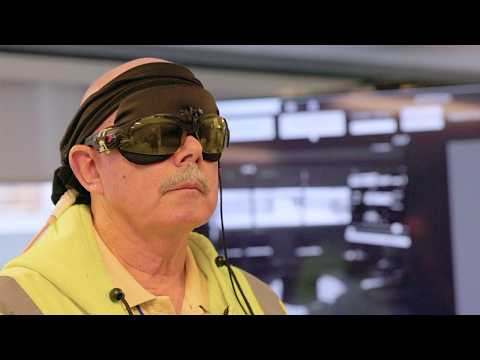
A third surgery performed at 海角原创 has marked a new chapter in advancing vision restoration for people with total blindness.
The , designed to provide artificial vision, was placed successfully in a third participant in . The ICVP is a revolutionary wireless brain implant that bypasses the retina and optic nerves to connect directly to the brain鈥檚 visual cortex.
Developed by a multi-institution team led by , executive director of the at and professor of biomedical engineering, this third implantation underscores the scalability and robustness of the system. The ICVP is the culmination of nearly three decades of work dedicated to providing artificial sight to those who have lost their vision through eye disease or trauma.
鈥淭he success of this third implantation of the ICVP represents an important step forward in offering a meaningful option for patients with profound vision loss,鈥� says Sepehr Sani, MD, Rush professor of neurological surgery, program director for the Stereotactic & Functional Neurosurgery Fellowship program and the surgeon who implanted the device.
鈥淭his project underscores the immense possibilities of neurotechnology. By translating decades of research into real-world applications, we are forging new pathways to enhance lives,鈥� Troyk says. 鈥淲e鈥檙e driven by the potential of this technology to restore autonomy and improve the quality of life for individuals living with blindness. This novel brain interface technology has potential applications for other neural conditions, including those in the spinal cord, and we are pursuing those as well.鈥�
Unique advantage for researchers
The Intracortical Visual Prosthesis System is the first to use a group of fully implanted miniaturized wireless stimulators to explore whether people with blindness can use the artificial vision provided by this approach. It allows devices to be permanently implanted 鈥� a unique advantage that provides researchers ample time to explore how the device can effectively work and for the recipient to learn how the device can be useful.
During the preclinical phase, the Illinois Tech team worked with 海角原创 neurosurgeons to develop and refine surgical procedures, culminating in this week鈥檚 successful implantation of 34 stimulators with a total of 544 electrodes in an individual with blindness. The clinical phase is aimed at testing whether this prosthesis will provide study participants with an improved ability to navigate and perform basic, visually guided tasks. Throughout the clinical trials, Rush's epilepsy, psychiatry, ophthalmology and imaging specialists provide ongoing support to the participants.
鈥淔or people who are completely blind, even the ability to perceive a small amount of light can profoundly impact their daily lives,鈥� said Janet P. Szlyk, president and CEO of the Chicago Lighthouse. 鈥淭he results from this research open doors to transformative advancements in blindness research and vision restoration.鈥�
Collaborative effort
The project is a collaboration between Illinois Tech, 海角原创, the Chicago Lighthouse, the Wilmer Eye Institute at Johns Hopkins, the University of Texas at Dallas, Microprobes for Life Science, Sigenics Inc., and the University of Chicago on the initiative. Troyk serves as the principal investigator.
鈥淲e鈥檙e driven by the potential of this technology to restore autonomy and improve the quality of life for individuals living with blindness,鈥� Troyk says.
The project is calling for research volunteers who lost their vision as an adult but who had normal or near-normal vision for at least the first 10 years of life. Following surgery and approximately one month of surgical recovery, participants will be studied for one to three years, depending on the date of implantation. Learn more at or email icvp@illinoistech.edu.


